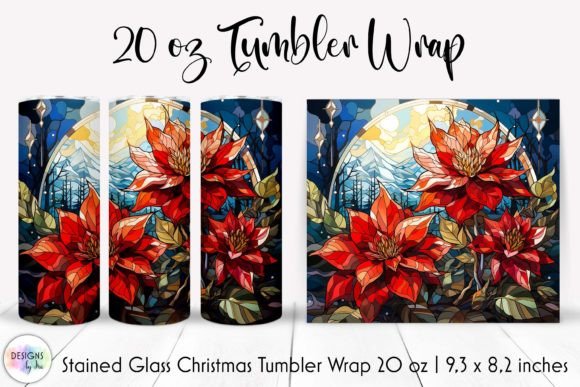
Christmas Poinsettia Tumbler Wrap Design
When I first opened the Christmas Poinsettia Tumbler Wrap Design, I was looking at it not as a sublimation artist or a tumbler maker, but through the eyes of an embroidery designer. The file is a clean, high‑resolution PNG at 300 dpi, sized for a 20 oz straight tumbler wrap — 9.3 by 8.2 inches. That dimension immediately tells me two things. First, the graphic is large enough to fill a generous hoop without losing detail. Second, the stained‑glass composition, with its crisp black outlines and jewel‑toned winter palette, is practically begging to be translated into thread.
I’ve been testing digital art assets for embroidery conversion for years, and this one hit a very specific mood. The poinsettia blooms are front and center, framed by geometric winter accents — snowflake‑like shapes, holly leaves, and soft icy blue panels. The stained‑glass effect gives it a church‑window reverence, which makes the whole piece feel more like a holiday heirloom than a quick seasonal graphic. It’s elegant, deliberate, and slightly nostalgic. For a handmade product, that emotional pull is gold. I could already picture it stitched onto a creamy linen pillow cover or a deep forest‑green tote bag, with metallic gold thread catching the light in the same way a real stained‑glass window does.
Stained Glass Visuals and the Embroidery Mindset
The stained‑glass style is a natural fit for machine embroidery because it relies on strong, continuous outlines — essentially a built‑in running stitch or satin stitch pathway. When I zoomed into the file, the black boundary lines were bold and well‑separated, which will make digitizing far easier than designs with muddy, low‑contrast edges. This is crucial: if the outlines were thin or broken, the digitizer would have to redraw them manually, adding hours to the prep work. Here, the structure is already there. Each colored segment is distinct, and the palette stays within a manageable range — deep reds, forest green, icy blue, crisp white, and a few touches of gold. That limited thread count is a plus for any small‑batch embroidery project, because it reduces the number of thread changes and keeps the production time realistic.
I do want to point out a small design observation that can affect how the Christmas Poinsettia Tumbler Wrap Design behaves on fabric. The stained‑glass segments are filled with gradients and slight texture, typical of a digital illustration. In embroidery, those gradients have to be translated into flat fill stitches, often with a bit of dithering or creative layering. The mood stays intact, but the final stitched result will feel more tactile and less smooth than the screen image. That’s not a flaw — it’s just the nature of thread. In fact, the subtle texture of fill stitches can give the design a cozy, hand‑worked charm that a printed tumbler wrap can’t quite replicate. I’d lean into that by using a matte polyester thread, like Madeira or Isacord, for a soft, non‑shiny finish on the reds and greens, and then add one or two accent colors in a gentle metallic for the snowflake centers. That contrast will make the piece feel intentional and high‑end.
Real‑Project Test: From Tumbler Wrap to Embroidered Tote
To ground this review, I walked through a real scenario I’d use for a client project. A boutique owner asked me to create a limited‑edition holiday gift — an embroidered organic cotton tote bag with a decorative front panel. She wanted something that felt like a keepsake, not a mass‑produced item. The Christmas Poinsettia Tumbler Wrap Design immediately came to mind because the proportions of the file, when scaled down slightly, would sit beautifully on the center of the bag. I resized the graphic to about 7 inches wide, keeping the aspect ratio intact, and tested the visibility of the internal stained‑glass lines. At that size, the smallest details — like the tiny holly berry dots — remained clear enough to digitize with a narrow satin stitch, but I’d recommend a test stitch‑out on a scrap of the same cotton you’ll use for the final product. Those tiny berries are the first place where stitch density can either shine or turn into a lumpy mess, especially on a textured fabric like woven canvas.
For the tote bag, I’d use a medium‑weight cut‑away stabilizer, and I’d float a piece of no‑show mesh behind the design area because the stitching will be dense. The stained‑glass style, with its large filled areas, demands a lot of thread coverage. If you’re new to converting graphics like this, remember that the black outlines are your friend — they hide the junction between fill areas and forgive minor registration shifts. I’d digitize the outlines first as a single‑pass running stitch to secure the fabric, then fill the colored sections, and finally overlay the outlines again with a slightly wider satin stitch for that bold, leaded‑glass look. This approach, while time‑intensive, rewards you with a crisp, professional finish that customers genuinely notice.
Where This Design Shines and Where to Be Careful
The strengths of the Christmas Poinsettia Tumbler Wrap Design in an embroidery context are clear. It’s a ready‑made composition that doesn’t need extra borders or text to feel complete. The winter theme is broad enough to work for Christmas, generic holiday, and even late‑autumn gifting. The stained‑glass structure gives it a unique, slightly art‑deco vibe that stands out in a sea of chalkboard‑style and rustic farmhouse designs. I’d use it confidently on flat or gently curved surfaces: tote bags, apron bibs, pillow covers, tea towels, and the backs of denim jackets. It will also work on a structured sweatshirt front, but I’d avoid placing it on the chest area of a thin, stretchy knit without a lot of backing — the density of the fill stitches can cause puckering on lightweight fabrics.
However, there are practical limits. Because the original file is meant for a straight tumbler, the layout is a rectangular, horizontal composition. That’s great for a tote bag or a pillow, but awkward for a cap or a narrow hat panel. You could rotate it, but the stained‑glass window effect reads best in its intended orientation. Also, the design includes small decorative elements, like the snowflake interiors and the poinsettia center details. These will require careful digitizing and a hoop size that can handle the whole design in one go. If you’re working with a 4×4 inch hoop, this design will feel cramped — I’d recommend a minimum of 5×7 inches, and ideally larger, to preserve the details and keep the outlines from merging. On projects like baby clothes or delicate knit blankets, consider scaling down and simplifying the fill to avoid overly stiff patches.
Customer Perception and Product Value
When I think about the finished product, I imagine a customer unwrapping a linen pillow cover with this design stitched in deep burgundy and spruce green, with a single gold thread highlight. The stained‑glass effect reads as thoughtful, deliberate, and slightly luxurious. That perception directly affects what you can charge. A design that looks like a quick monogram or a simple silhouette blend will land in the budget‑friendly price range. But a design like the Christmas Poinsettia Tumbler Wrap Design, executed well, positions your handmade item as a premium gift. It also works beautifully for personalized products — you could add a family name or a short date in the lower panel without breaking the composition. That small customization option turns a lovely embroidery into a repeat‑selling design for an Etsy shop or a craft fair booth.
From a branding perspective, the stained‑glass theme is consistent and recognizable. If you use it across a small collection — a tote bag, a matching apron, a tea towel set — you create a cohesive look that customers remember. The design itself is not a generic poinsettia; it has a clear artistic signature. And because it’s delivered as a high‑resolution PNG, you have the flexibility to create printed mockups for your shop listings, social media previews, or even a printable card that accompanies the embroidered gift. That visual continuity between your online presence and the physical product builds trust and encourages repeat buyers.
Practical Notes for Digitizing and Stitching
Before you commit to a large batch of embroidered products, I always recommend a few practical checks. First, test the design on a fabric similar to your final material. The Christmas Poinsettia Tumbler Wrap Design has a lot of dark, saturated areas, so thread color contrast is critical. A deep red thread on a dark navy fabric might disappear, so either lighten the thread shade slightly or choose a fabric that provides a good backdrop. I often test my designs in black‑and‑white first — just print the graphic in grayscale to see if the values still hold up. With this design, the values are distinct enough to work even without color, which is a sign of a well‑balanced composition.
Second, check the stitch density after digitizing. The stained‑glass fill areas can become very dense, especially if you’re trying to match the smooth gradients of the original PNG. A better approach is to use a moderately dense tatami fill with a subtle pattern, and rely on the bold outlines for definition. That keeps the fabric from getting stiff and reduces the risk of thread breaks. I’d also limit the number of trims and color stops by grouping same‑color segments together in the digitizing software. The design’s natural segmentation makes this fairly easy — you can sequence all the red fills, then the greens, then the blues, and finally the outlines.
Third, review the licensing if you plan to sell items made with this graphic. The product description states it’s a PNG file for a tumbler wrap, but as an embroidery designer who converts the art into a stitch file, you need to be clear on what the original seller allows. Can you digitize it and sell the resulting embroidery file? Can you stitch it on physical products for commercial sale? Always verify these rights before adding the design to your shop inventory. I can’t give you that information here, but it’s a step you should never skip. The same care applies to any digital asset you source for embroidery.
Final Thoughts for Embroidery Designers and Makers
After spending time with the Christmas Poinsettia Tumbler Wrap Design, I’d say it’s a strong candidate for embroidery projects that want a polished, slightly formal holiday look. It’s not the quickest design to digitize — the stained‑glass details require patience and a good eye for stitch sequencing — but the result is absolutely worth the effort. For a handmade shelf, a boutique gift line, or a personal holiday project, this design will draw attention because it feels different from the typical embroidered snowman or rudimentary tree. The prominent poinsettia, the wintery cool tones, and the structured layout give it a sense of occasion.
If you’re an Etsy seller, a small shop owner, or a craft business looking to add a sophisticated seasonal piece, this is the kind of art that translates beautifully into thread. Just remember to test it thoroughly, choose your fabric and stabilizer with care, and lean into the bold outlines that make the stained‑glass style so compatible with machine embroidery. The Christmas Poinsettia Tumbler Wrap Design may have arrived as a tumbler wrap, but in the hands of an embroidery designer, it becomes a versatile, beautiful asset for apparel, home decor, and heart‑felt gifts.