Vintage Skeleton Santa Tumbler Wrap: A Designer's Honest Review
I've spent years working with embroidery files, digitizing artwork, and testing how designs actually behave on fabric. When I first saw the Vintage Skeleton Santa Tumbler Wrap, I wasn't looking for another holiday motif. But something about the strange, slightly offbeat mix of skeletal anatomy and Santa imagery made me stop scrolling. It's not cutesy, and it's not trying to be scary. It lands in a weird, wonderful middle ground that feels more like old botanical illustration meets punk rock Christmas card. That's the kind of visual personality that gets my attention as a designer.
Now, I should be upfront. This is a print template—a digital download with PNG files sized for 20 oz. straight, 20 oz. tapered, 30 oz. straight, and 30 oz. tapered tumblers. It's not an embroidery file. If you're an embroidery designer like me, you're going to need to digitize this artwork yourself or hire someone to do it. But the question I always ask is: does the artwork itself justify the effort? After spending time with all three included designs, my answer is yes, with some thoughtful caveats.
First Impression: Moody, Vintage, and Strangely Charming
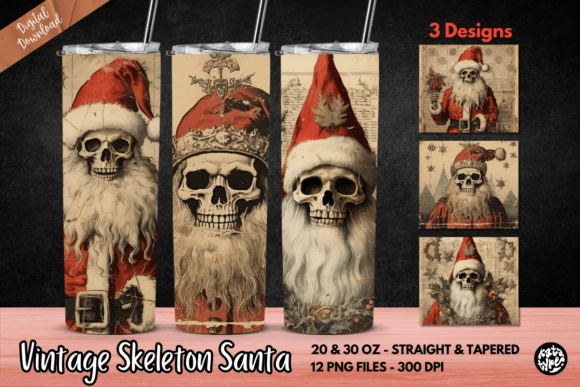
The Vintage Skeleton Santa Tumbler Wrap set carries a distressed, woodcut-illustration feel. The linework has that old etching quality—think 19th-century anatomical drawings crossed with a holiday gag that somehow holds together. The skeleton Santa doesn't leer or grimace. The expression reads more like a tired, knowing wink. That subtlety matters. It means the design can work for adults who want holiday decor that doesn't scream, and it can also appeal to the alternative craft crowd who love skulls, gothic aesthetics, and vintage curiosities.
The three designs give you variation without losing the cohesive theme. One might lean more detailed, another slightly simplified. As someone who digitizes for embroidery, I immediately start mentally separating the linework into what will become running stitch outlines, what needs satin stitch accents, and where fill stitch sections might get too dense. The vintage texture—those little speckles and worn edges—won't translate directly into thread. But the bones of the artwork are strong enough that you can build a clean embroidery file from them.
Where This Design Would Actually Shine in Embroidery
I mentally test every design against real products. Here's where the Vintage Skeleton Santa Tumbler Wrap artwork would thrive in stitched form.
Custom Sweatshirts and Hoodies
This is the obvious home run. A black or charcoal sweatshirt with the skeleton Santa embroidered on the chest or across the back would sell instantly at a craft fair or on Etsy. The contrast of dark fabric with off-white or cream thread would mimic that vintage etching look beautifully. I'd use a medium-weight cutaway stabilizer and keep the stitch count reasonable—probably under 12,000 for a chest-sized design. The key is preserving the negative space that gives the skeleton its readability.
Canvas Tote Bags and Market Bags
Sturdy canvas handles embroidery well, and the flat surface means you won't fight curves. A tote bag with this design stitched in muted thread—think bone white, dusty red for the hat, maybe a touch of dark grey for shadows—would look like something from an indie boutique. Customers who buy handmade totes often want conversation starters. A skeleton Santa absolutely delivers that.
Kitchen Towels and Tea Towels
Here's where the vintage vibe really clicks. A flour-sack tea towel with this design embroidered in a single color—maybe deep burgundy or forest green—feels like a quirky heirloom. The fabric texture adds to the aged look. Just be careful with towel nap. You'll want a water-soluble topper so the stitches don't sink into the fibers, and the design needs to be simplified enough that small loops and terry cloth don't eat the fine details.
Embroidered Patches
I can absolutely see this as a sew-on or iron-on patch. The circular or badge-like composition of tumbler wrap artwork often adapts well to patch formatting. A patch with merrowed edges and the skeleton Santa in crisp thread would appeal to the punk, goth, and alternative holiday crowd. Patches are low-risk, high-margin products for small shops, and this design has the right attitude.
Real-Life Scenario: A Boutique Holiday Collection
Let me walk you through how I'd actually use the Vintage Skeleton Santa Tumbler Wrap in a real project. I'm imagining a small boutique getting ready for a December market. The owner wants something different from the usual reindeer and snowflakes. She serves customers who love dark humor, vintage aesthetics, and slightly macabre decor.
I'd take one of the three designs, digitize it for a 5x7 hoop, and stitch it onto heavyweight cotton canvas tote bags in natural and black. I'd use a matte polyester thread—off-white for the skeleton, a muted brick red for the Santa hat trim, and maybe a subtle olive green for holly accents if the design includes them. The finished bags would retail for $28–$35 each. They'd photograph beautifully, and the unusual design would stop scrollers on Instagram or Etsy. That's the practical value of artwork that refuses to be boring.
Where You Need to Be Careful
Not every product is a good fit. Here's what I'd watch out for with the Vintage Skeleton Santa Tumbler Wrap artwork.
Small Hoop Sizes
If you try to cram this into a 4x4 hoop, those fine skeletal details will close up. Fingers, ribs, and facial features need breathing room. I'd recommend a minimum 5x7 hoop for most versions, and 6x10 or larger if you want the full impact. Test stitch your digitized file on scrap fabric before committing to a production run. Small lettering—if any of the designs include text—is the first thing to fail at tiny sizes.
Stretchy and Thin Fabrics
Jersey knits, lightweight modal, and thin cotton blends can pucker under dense stitch areas. The skeleton's ribcage and any filled sections will pull if you don't use the right stabilizer. A good cutaway stabilizer is non-negotiable. For very thin fabrics, add a layer of fusible interfacing behind the embroidery area. The design's linear nature actually helps here—lots of open space means less stitch density, which means fewer puckering problems.
Dark Fabrics and Color Contrast
The vintage etching look depends on contrast. On a black sweatshirt, off-white thread creates that antique engraving feel. But on a medium grey or navy fabric, the contrast might get muddy. Test your thread colors on the actual fabric you'll use. I sometimes do a quick black-and-white mockup printout of the design and lay it on the fabric just to check how the values read from a distance.
Curved Surfaces Like Caps
Caps are tricky for any design with fine horizontal detail. The curve of a baseball cap can distort the skeleton's proportions. If you're determined to put this on a cap, center the design on the front panel, use a cap-specific hoop, and be prepared to simplify the artwork. A version with bolder, chunkier lines will stitch cleaner on curved surfaces.
What the PNG Files Actually Give You
The product delivers three designs, each in four PNG variations: 20 oz. straight shape, 20 oz. tapered shape, 30 oz. straight shape, and 30 oz. tapered shape. These are print templates built for tumbler sublimation. If you're an embroidery designer, you're not going to open these and send them to your machine. You'll need to use them as reference artwork for digitizing. That means importing the PNG into your digitizing software, tracing the key elements, and building a stitch file from scratch.
The good news is that the PNG format gives you clean, high-contrast artwork to work from. The straight and tapered variations help you see how the composition adapts to different proportions, which is useful when you're deciding whether to digitize for a horizontal layout on a sweatshirt or a more vertical placement on a tote bag.
Thread Colors and Stitch Strategy
If I were digitizing the Vintage Skeleton Santa Tumbler Wrap for embroidery, I'd keep the thread palette tight. Three to five colors maximum. The skeleton itself works best in a single off-white or bone thread with maybe a light grey for shading. The Santa hat can carry the only real pop of color—a deep, dusty red that doesn't feel too bright. The vintage mood dies if you use candy-apple red or neon anything. Stick to muted, earthy tones. Think about how a 100-year-old print would look faded by sunlight. That's your color reference.
Stitch types matter too. I'd use mostly running stitch for the fine linework, satin stitch for hat bands and any bordered elements, and light fill stitch only where absolutely necessary. Over-digitizing this style of artwork—adding too much density, too many trims, too many color changes—will kill the charm. The beauty is in the spare, etched quality. Let the fabric show through.
Customer Reactions and Product Value
I've sold enough handmade products to know that unusual designs polarize. Some people will see the skeleton Santa and immediately laugh, connect with it, and buy. Others will scroll past, confused. That's fine. You don't need universal appeal. You need the right customers—the ones who feel like this design was made for them. Those customers tend to be loyal, repeat buyers who talk about your shop to their friends.
The Vintage Skeleton Santa Tumbler Wrap artwork adds a layer of personality to your product line that mass-produced holiday items can't match. When a customer sees this on a tote bag or sweatshirt in your booth, they know immediately that you're not selling generic holiday merchandise. You're curating a specific aesthetic. That builds trust and brand recognition faster than playing it safe.
Practical Reminders Before You Stitch or Sell
Here are the things I always check before putting a design into production, and they apply here too.
- Test on scrap fabric first. Run a full stitch-out and look for gaps, thread breaks, or density issues. Fix them before you touch your good inventory.
- Confirm your hoop size. Make sure the digitized version actually fits the hoop you plan to use. Don't assume.
- Check thread contrast. What looks great on screen might read poorly on textured or dark fabric. Do a quick contrast check.
- Use proper stabilizer. For this style of design with its mix of open space and detail, I recommend a medium cutaway for knits and a tear-away for woven fabrics.
- Verify licensing. The product description mentions this is a digital download. Before you sell finished items with this artwork stitched on them, confirm the commercial use terms. Some designers allow it, others don't. Don't assume—check.
- Compare light and dark backgrounds. The skeleton reads differently on white canvas versus black denim. Test both if you plan to offer color options.
Who Should Actually Use This Design
If you're an embroidery designer, a small shop owner, an Etsy seller, or a hobbyist who loves slightly dark, vintage-inspired holiday aesthetics, the Vintage Skeleton Santa Tumbler Wrap is worth your attention. The artwork is distinctive, the mood is memorable, and the three variations give you flexibility. You'll need to invest time in digitizing—or pay a digitizer—but the resulting stitched products can stand out in a crowded market.
If you're looking for a plug-and-play embroidery file that you can load onto your machine and stitch immediately, this isn't that. This is a print template, a graphics asset. But for the designer who's comfortable with the digitizing step, or who wants to expand into sublimation and embroidery with coordinating artwork, this set bridges both worlds nicely.
Final Thoughts From the Worktable
I've reviewed hundreds of design assets over the years, and the ones that stick with me are the ones that make me want to stitch something. The Vintage Skeleton Santa Tumbler Wrap did that. I'm already thinking about a heavyweight canvas apron with the skeleton Santa embroidered large on the front, maybe with a subtle split-stitch texture to mimic the etched lines. That's the sign of good artwork—it sparks ideas. It suggests products. It doesn't just sit there looking pretty in a folder.
For embroidery use, the path from PNG to finished stitch requires work, but the destination is worth the journey. The vintage skeleton Santa concept is quirky enough to grab attention, timeless enough to avoid feeling trendy, and versatile enough to live on garments, home goods, and accessories alike. If your creative business thrives on designs that feel handpicked and personality-driven, this one belongs in your toolkit.